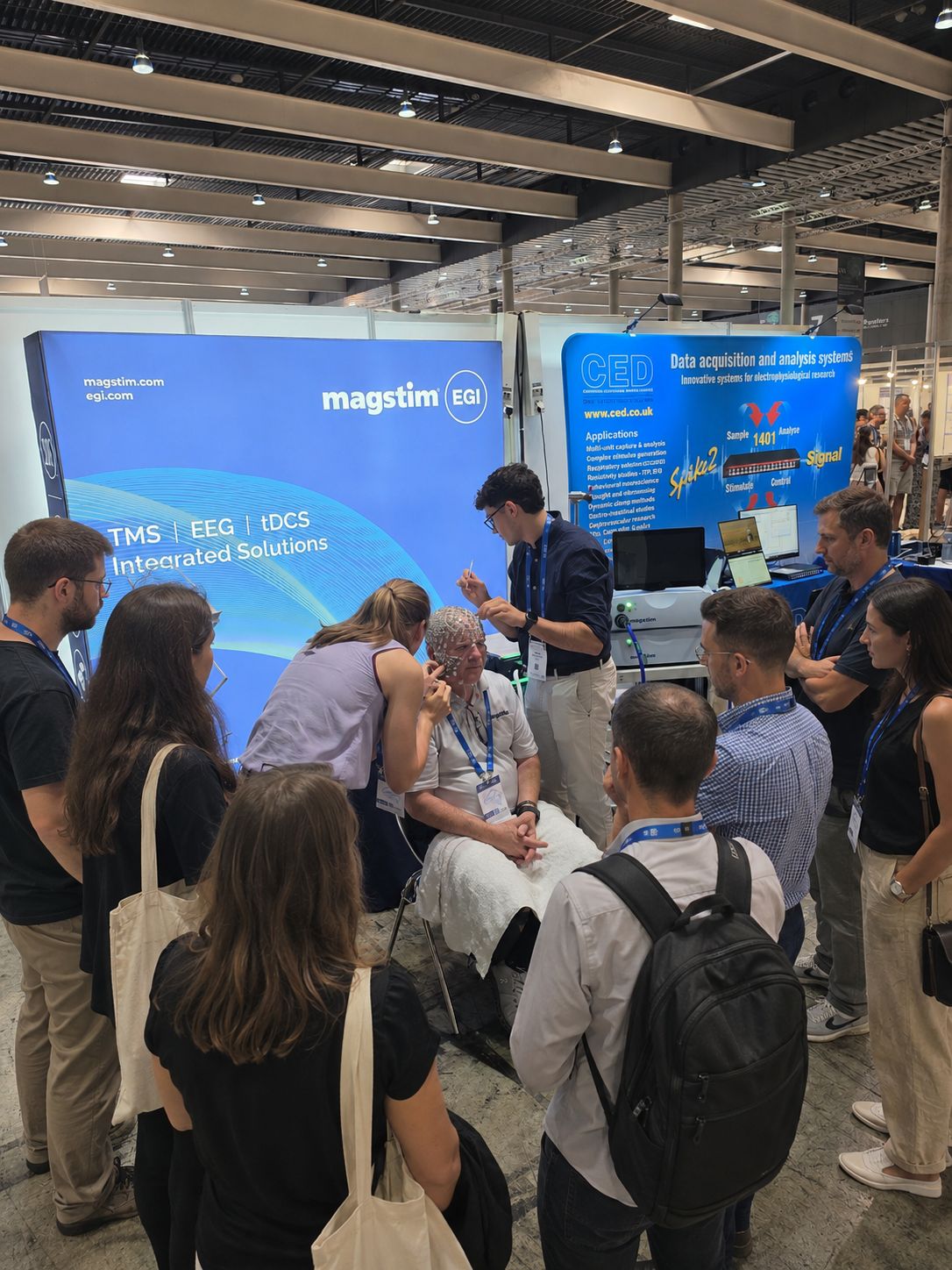
How does TMS work?
A coil near the head produces a changing magnetic field, inducing an electric field in tissue. Distribution depends on the coil, orientation, distance and anatomy. A point shown in an illustration therefore does not precisely bound the stimulated area.
In motor research, an electromyographic muscle response can help study corticospinal excitability. With EEG, the aim is to study electrical responses after stimulation, subject to appropriate artefact processing. Discuss TMS applications with Gaze Intelligence →
Single pulses, paired pulses and rTMS
| Approach | How it informs equipment selection |
|---|---|
| Single pulse | Study a response to one pulse; specify coil, waveform and associated measurements. |
| Paired pulses | Define required intervals, intensities and the setup delivering both pulses. |
| Repetitive stimulation — rTMS | Assess trains, rate, operation at required power and thermal management. |
Compare the complete system, not a maximum frequency
A maximum frequency does not describe all operating conditions. Specify power, sequences, train duration and rest periods, then check that the system and coil can deliver them. Refer to the chosen model's documentation.
The range on our Magstim TMS page distinguishes M200², BiStim² and New Rapid, followed by Horizon clinical systems. The catalogue compares families and accessories. Product references should not be treated as interchangeable without reviewing the configuration.
TMS–EEG: measure responses while distinguishing artefacts
The stimulation pulse creates demanding EEG conditions. Signals may include recording-system, muscle and sensory contributions from the click or contact. Analysis must distinguish observations from what can be attributed to cortical responses.
A TMS–EEG study by Poorganji and colleagues examines cortical versus auditory responses with single and paired-pulse protocols. It highlights appropriate control conditions, not a universal interpretation of every component. Read this publication.
Research and therapy: two distinct settings
Therapeutic use cannot be inferred simply because a device produces TMS pulses. It depends on the device, intended use, applicable indications and clinical organisation. Patient and protocol decisions belong to a qualified medical team.
This article presents principles and equipment criteria, not stimulation settings or treatment protocols. For a care project, specify the clinical context at the outset to identify the appropriate range and documentation.
Prepare a TMS configuration request
- Specify research, clinical research or care.
- Describe protocol families and required equipment characteristics.
- Specify coils, support, chair and available space.
- List associated measurements: EMG, EEG, neuronavigation or other interfaces.
- Plan training, installation, checks and initial support.
Sources and documentation
Technical documentation and further reading.