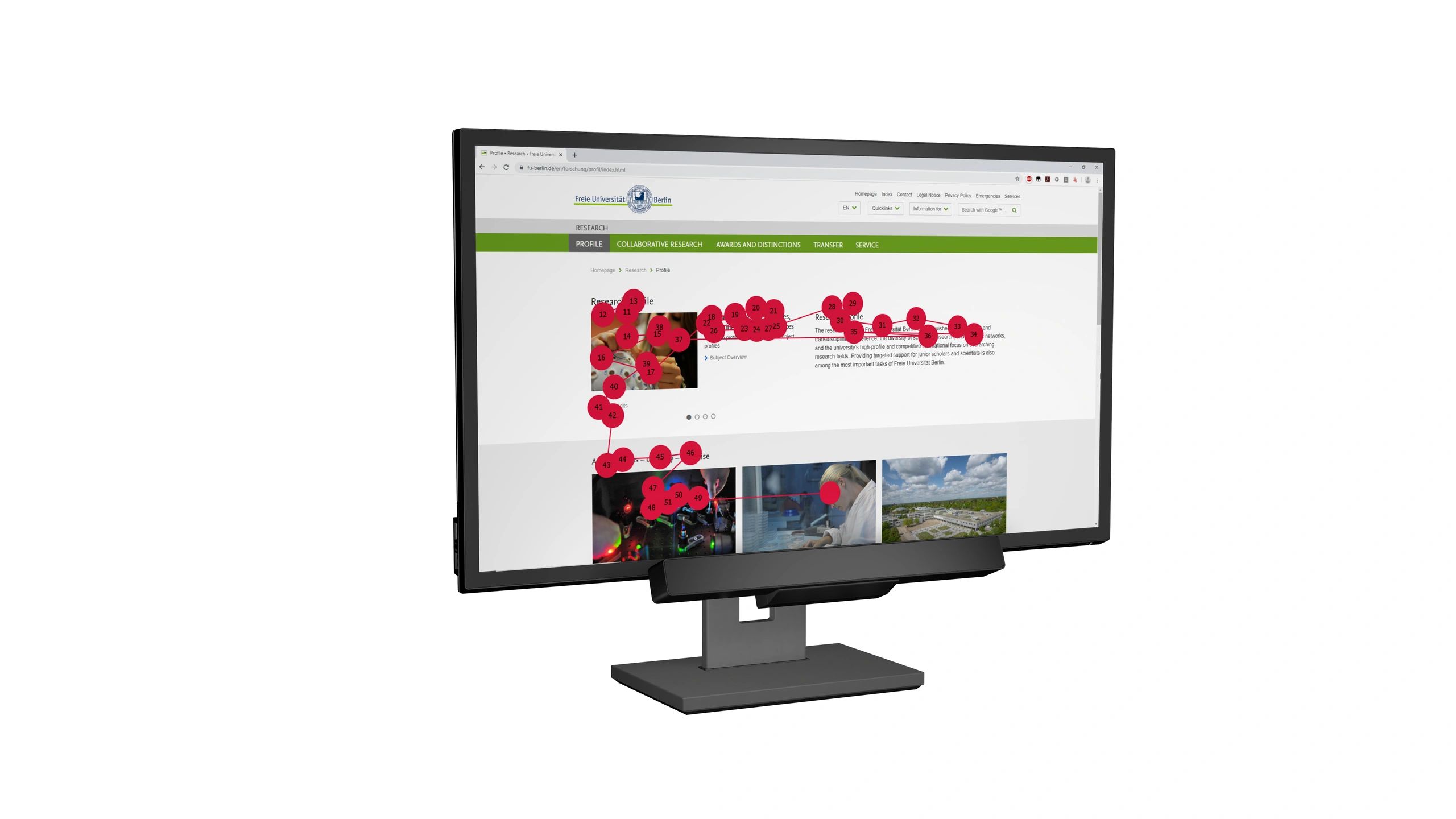
What each measurement adds
The eye tracker estimates where and when a participant looks. EEG records electrical activity whose dynamics can be examined around events. Together they can address reading, scene exploration or target search. They cannot directly read thoughts or infer preference from a single signal.
First define the relevant behavioural variable: first fixation on an area, gaze duration, return to a target or response after exploration. This guides event detection settings and quality checks.
Fixation-related potentials
In fixation-related potential analysis, EEG segments are aligned to fixation onset rather than only stimulus onset. This can be useful during free viewing, when the eyes do not remain still.
Dimigen and colleagues' work on natural reading describes technical and analytical issues in co-recording, including synchronisation and ocular artefacts. A fixation is not isolated: responses to nearby events may overlap. Methods must therefore fit the task dynamics. Read the reference paper.
Synchronise devices and the stimulus
Establish timestamp origins and how events reach each device. Experiment software timestamps may precede actual stimulus display. Similarly, a received stream may have undergone internal latency before transmission.
Plan a measurable end-to-end test: repeat a shared event, examine offset and variability, and document any correction. A software interface alone does not remove the need for this check. Plan your synchronisation architecture.
Distinguish eye movement from brain response
Eye movements and blinks contribute to EEG. Eye tracking can help identify them, but does not automatically clean the recording. Tracking loss, calibration changes and EEG channel quality must also be monitored.
Condition comparisons need care: different scanpaths may produce different event sequences and overlaps. Defining controls before analysis helps avoid premature interpretation of observed differences.
Choose an eye tracker for an EEG study
| Need | What to check |
|---|---|
| Timing | Sampling rate suited to the events and access to timestamps. |
| Geometry | Screen distance, target size and freedom of movement. |
| Population | Tracking quality, comfort and calibration with study participants. |
| Integration | Events, documented interfaces, exports and software versions. |
| Analysis | Access to valid data, detection settings and metadata. |
Pilot before deployment
Prepare a short task with representative stimuli. Check that files open in your tools, trials are identifiable and expected events can be reconstructed. Examine missing data and tracking stability before scaling up sessions.
Gaze Intelligence helps you select eye tracking systems, EEG equipment and interfaces to test. For a quotation, specify existing equipment and the outputs your processing pipeline must produce.
Sources and documentation
Technical documentation and further reading.